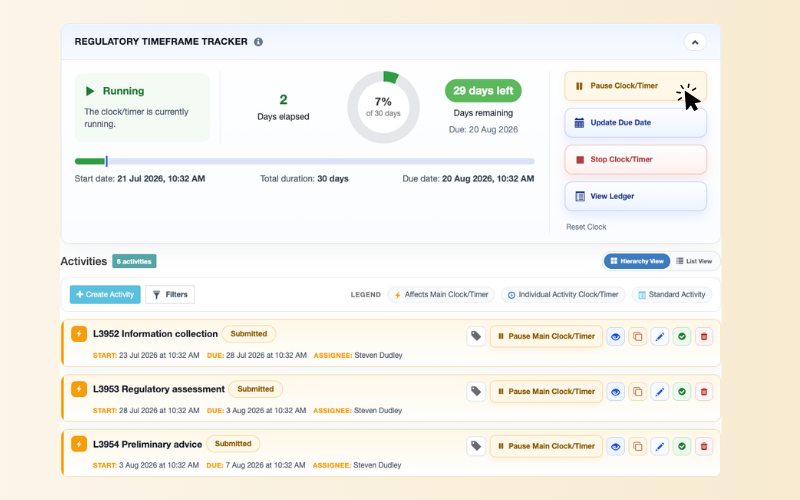
Lawcadia provides a secure, configurable platform for managing the complete Freedom of Information process from request through to final response.
The platform helps teams:
Features include:
Lawcadia provides a configurable platform that supports the complete lifecycle of Freedom of Information requests, helping organisations standardise processes, improve visibility and reduce administrative effort.
Frequently Asked Questions
What is Freedom of Information software?
Freedom of Information software helps public sector organisations manage the end-to-end lifecycle of FOI requests. It provides a structured system for registering requests, assigning work, managing statutory deadlines, coordinating reviews, storing documents, tracking decisions and maintaining a complete audit trail. Rather than relying on spreadsheets and email, organisations can manage the entire process within a single platform.
How does FOI software improve compliance?
FOI software helps organisations comply with legislative obligations by standardising processes, automating workflow steps and improving visibility across every request. Features such as automated deadline calculations, reminders, approval workflows and reporting reduce the risk of missed statutory timeframes and provide managers with oversight of workload and performance. Timely responses are a core expectation under Freedom of Information legislation.
Can FOI software calculate statutory deadlines?
Yes. Modern FOI software can automatically calculate statutory response deadlines, taking into account the relevant legislative requirements for the jurisdiction. Advanced platforms also support pausing, extending, restarting and resetting statutory timeframes where legislation permits, while maintaining a complete audit trail of all deadline calculations and decisions.
How does Lawcadia support Freedom of Information requests?
Lawcadia provides a configurable platform for managing the Freedom of Information process. Teams can register requests, allocate work, automate activities, calculate statutory timeframes, coordinate reviews, manage documents, track approvals, monitor progress through dashboards and maintain a complete record of every action taken. The platform is configurable to reflect different jurisdictions, organisational policies and governance requirements.
Is Lawcadia suitable for government organisations?
Yes. Lawcadia is designed for government, public sector and regulated organisations managing complex legal, regulatory and information governance processes. Its configurable workflows, strong security controls and comprehensive reporting make it well-suited to reportable data breaches, privacy breaches, Freedom of Information and Right to Information requests, data subject access requests, Standing Order 52 (SO52) requirements and GIPA applications.
What security standards does Lawcadia provide?
Security is embedded throughout the platform. Lawcadia maintains ISO 27001 certification and Cyber Essentials Plus certification and provides enterprise security features including encryption, role-based permissions, audit logging, multi-factor authentication, Single Sign-On (SSO) and data hosting through Amazon Web Services (AWS) in the local AWS region.
Can Lawcadia integrate with existing government systems?
Yes. Lawcadia integrates with Microsoft technologies including Outlook, Word, SharePoint and Microsoft Entra ID, and supports integration with document management systems and other enterprise platforms such as OpenText Content Manager and iManage. This enables organisations to modernise their FOI processes while continuing to use their existing technology stack.
Can Lawcadia manage other statutory request types?
Yes. Because Lawcadia is a configurable legal operations platform, it can support a wide range of statutory and regulatory request processes beyond Freedom of Information. These include reportable data breaches, privacy breaches, data subject access requests, Standing Order 52 (SO52) requirements, GIPA applications, and other legislated workflows that require structured processes, statutory deadline management, and comprehensive auditability.