


Most in-house legal teams know they want to operate more efficiently. Fewer have a clear picture of where they currently sit, what the next stage looks like, or what it genuinely takes to get there.
A maturity model is useful precisely because it clarifies the practical steps for improvement. It translates general goals into a concrete understanding of current strengths and development areas, providing clear pathways for growth.
For General Counsel and Legal Operations leaders, this enables clearer dialogue with Finance and the business, justifying investments and allocating resources to achieve measurable improvements in delivery and value.
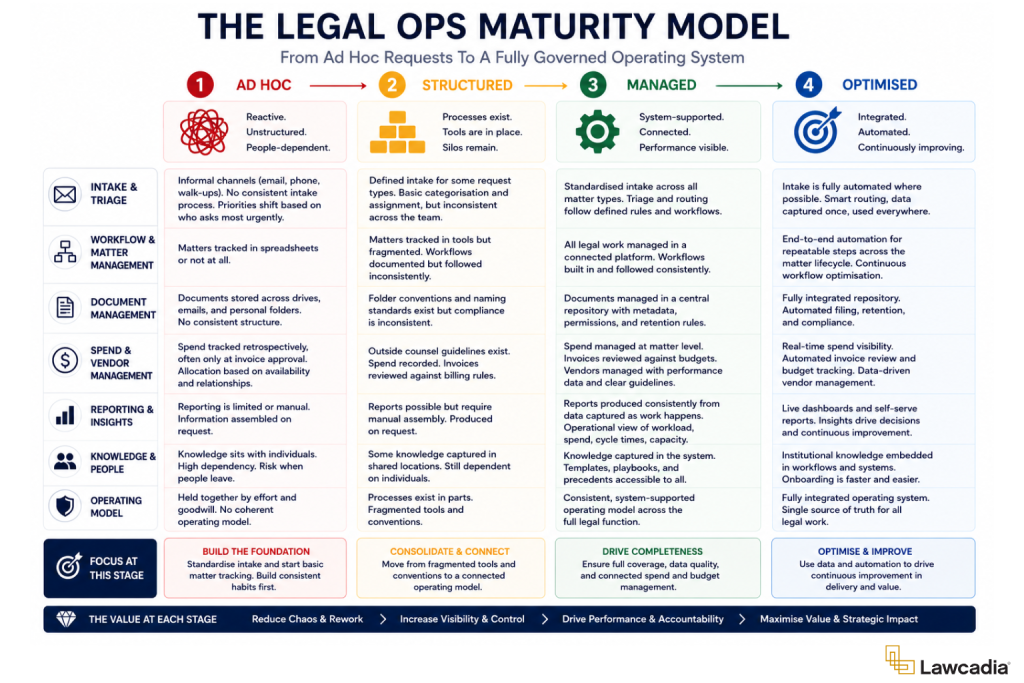
Four Stages of Legal Ops Maturity
Stage 1: Ad Hoc
Work arrives through informal channels: email, phone calls, direct messages, and corridor conversations. There is no consistent intake process. Allocation is based on availability and relationships rather than defined rules. Priorities shift according to whoever is asking most urgently.
Documents are stored inconsistently across shared drives, email threads, and personal folders. Matter information lives in spreadsheets maintained by individuals, if it is captured at all. Spend is tracked retrospectively, often only at invoice approval. Reporting is limited or produced manually for specific requests rather than as a reliable operational view.
Knowledge sits with individuals rather than in systems. When someone leaves or is unavailable, institutional memory goes with them. The function is held together by effort and goodwill rather than by any coherent operating model.
Most in-house teams recognise this stage. Many started here. Some are still operating this way in pockets, even where the overall function has matured in other areas.
Stage 2: Structured
The team has introduced basic process discipline across some parts of the operating model. There is a defined intake channel for at least some request types. Common matter types are tracked, though perhaps across multiple tools that do not connect. Law firm panels are formalised, spend is recorded, and invoices are informally checked and reviewed against billing guidelines.
Document storage is more organised, with folder conventions and naming standards, though compliance is likely to be inconsistent. Some workflows are documented and broadly followed under normal conditions. Reporting is possible but requires manual assembly and is produced on request rather than routinely.
This is where many in-house legal teams currently sit. It represents real progress from Stage 1, but the operating model is still fragmented. Different parts of the function run on different tools and different conventions. The team is more organised, but it is not yet operating from a single, coherent system. Coordination overhead is high, and the quality of the information available to leadership depends on how recently it was pulled together.
Stage 3: Managed
The function operates from a consistent, system-supported operating model that covers the full scope of legal work. Intake is standardised across matter types. Triage and routing follow defined rules. Workflows for common matters are built into the system rather than documented separately and followed informally.
Matter management, document management, and spend management operate from a connected platform rather than separate tools. Invoices are reviewed against matter-level budgets and approved through a structured process. Outside counsel relationships are managed with clear guidelines, defined scope, and performance data captured at the matter level.
Compliance requirements are built into workflows rather than managed as a separate exercise. Reporting is produced consistently from data captured as the team works, rather than assembled manually after the fact. Leadership has access to a reliable operational view of workload, spend, cycle times, and capacity.
At this stage, the legal function can have data-based conversations with Finance and the business about delivery, cost, and performance, directly showcasing its value to the organisation. The team is recognised as a reliable, managed function, leading to better resource allocation, improved decision-making, and greater organisational confidence in legal operations.
Stage 4: Optimised
The operating model is fully integrated. A single platform serves as the system of record for the entire legal function: every matter, every document, every external instruction, every invoice, every approval, every compliance obligation. Information is captured as the team works rather than entered retrospectively, which means the data is current, consistent, and trustworthy.
Workflows are automated for repeatable process steps across the full matter lifecycle, from intake and triage through to matter closure, document retention, and spend reconciliation. Automated workflows do not replace judgement; they handle the coordination, routing, and record-keeping that should not require a lawyer’s time.
Reporting at this stage is not a periodic exercise. It is a live, operational view available to the team and leadership at any time. Because the platform captures data consistently across all activity, reports on workload distribution, matter cycle times, spend by practice area, vendor performance, and compliance status reflect what is happening rather than what someone has recently had time to compile.
The legal function at this stage operates as a single source of truth for everything it touches. New team members can get up to speed because knowledge is in the system, not in someone’s head. Leadership can assess the function’s performance with confidence because the reporting is built on clean, consistent data. External counsel relationships are managed from a clear evidentiary base. And the legal team itself can focus on legal work rather than on coordinating, chasing, and manually assembling information.
Using the Model Practically
The value of a maturity model lies in its ability to provide specific guidance and clear priorities for improvement. By revealing concrete next steps tailored to the team’s current position, it enables focused action, better resource use, and consistent progress toward higher performance.
A team at Stage 1 needs to focus on intake standardisation and basic matter tracking before anything else. Introducing automation or new tools into an ad hoc process does not improve it. The priority is establishing consistent habits around how work is captured and categorised.
A team at Stage 2 needs to consolidate. The goal is to move from multiple disconnected tools and conventions toward a connected operating model where matter information, documents, spend, and workflows sit in one place and inform each other. That foundation makes consistent reporting possible and reduces the coordination overhead that consumes so much time at this stage.
A team at Stage 3 is ready to focus on completeness and consistency. Are all matter types covered by the operating model, or only the most common ones? Is data being captured consistently enough to trust the reporting? Are spend management and invoice review connected to matter-level budgets? Closing those gaps is what moves the function from managed to optimised.
A team at Stage 4 is focused on using the data the system produces to drive continuous improvement: identifying where cycle times are longer than expected, where spend is concentrating, where workflow steps are creating bottlenecks, and where service levels are not being met.
Conclusion
Across all four stages, the teams that progress most consistently share one characteristic: they treat Legal Ops as an operating discipline rather than a support function. They invest in systems, data, and processes with the same seriousness they bring to legal risk and to the quality of their advice.
The maturity model does not prescribe a timeline. It describes a direction. For most in-house legal teams, the most useful starting point is an honest assessment of where the function actually sits today, not where it aspires to be, and one clear decision about what changes next.
Download a copy of the diagram here.